20131220 Why Does Everyone Hate Bank of America but Love Wells Fargo?
Why Does Everyone Hate Bank of America but Love Wells Fargo?
Wells Fargo has been broadly more accepted than Bank of America -- and there's one reason that is true.
As the American economy has recovered from the financial crisis that
ravaged the economy, in the eyes of both individuals and investors, Wells Fargo (NYSE: WFC ) has had a distinct advantage over competitor and peer Bank of America (NYSE: BAC )
. Consider that the Reputation Institute recently showed that Bank of
America barely trailed Wells Fargo in the ratings from its customers,
yet Wells has one of the highest ratings from non-customers:
The performance
Yet its esteemed reputation isn't just in the eyes of the public, but among the investing community as well. Over the past five years, you can see Wells Fargo has been a resounding winner. $1,000 invested in Wells Fargo in December of 2008 would be worth nearly $1,650 today, and the same investment in Bank of America would be worth only $1,100, as shown in the chart below:

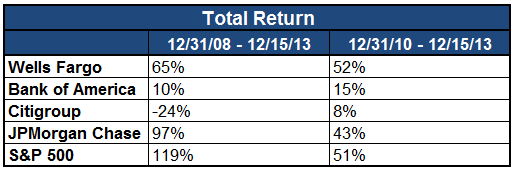
While both of those are still dramatically trailing the S&P 500 total return (up almost 120% over that same time period), the reality is that if you narrow that time frame to from December of 2010 until today, the total return of Wells Fargo stands at 52%, the S&P at 51% and Bank of America at 15%.
And it isn't solely Bank of America that Wells Fargo bests, but also other peers like Citigroup and JPMorgan Chase:
While JPMorgan takes the title as the five-year banking winner, if
you broaden the scope to 10 years, Wells Fargo has a total return of 95%
compared to JPMorgan Chase's 101% -- so the gap isn't as wide as first
glance may indicate.
So in all of this, the natural question becomes, what is Wells Fargo doing that has made it so much more successful than the other banks, both from an investing and public perception angle?
The reality
Curiously, although Wells Fargo's reputation greatly exceeds that of all three of its megabank peers, the reality is, the underlying data doesn't exactly support that notion.
According to the latest data from the American Customer Satisfaction Index, while Wells Fargo bests Bank of America with a rating of 72 versus 69, it trails both JPMorgan Chase (76) and Citigroup (74). In the 11 regions measured in the J.D. Power Banking Retail Satisfaction Index, the bank is considered among "The Rest" (the worst ranking) four times, and "About Average" the other seven. Bank of America's breakdown is six and five.
As it relates to foreclosures, Bloomberg reports that under the Home Affordable Modification Program (HAMP), Bank of America foreclosed on 33% of customers, but Wells Fargo stood at 27%. JPMorgan Chase and Citigroup each came in at 20%, and the industry average was 22%.
And it isn't even as though Wells Fargo has been immune to the settlements that have plagued the biggest banks lately. Although Bank of America tips the scales at $43.9 billion in settlements, and JPMorgan Chase sits at $26.4 billion, but Wells Fargo comes in third as it has doled out $9.5 billion. By comparison, Citigroup has only paid out $4.7 billion.
The realitySo what exactly is Wells Fargo doing? Well, first and foremost, although it seemingly leaves consumers in a bit of a lurch at times, it has delivered resounding growth in its profitability to its shareholders. Consider that it has delivered a new record net income each of the last 10 quarters. This steady rise in net income is dramatically different than the wild fluctuations of its peers:

Source: Company Investor Relations.
There are a myriad factors that all contribute to this, but I would
argue that one principal reasons is the simple fact that Wells Fargo has
been a dramatically safer bank. Consider its allowance for loan losses
as a percent of total loans compared to its peers:

Source: Company Investor Relations.
As you can see, this relative safety provided by an investment in
Wells Fargo is thanks in large part to the relative safety maintained by
the bank itself. This has undoubtedly allowed Wells Fargo to make it
through the financial crisis and emerge in a much better position than
its peers. This has allowed it to be a winning company for investors,
but what about consumers and the public?
The reason
Thinking back to the previously mentioned statistics, the reality is, Wells Fargo hasn't been the best bank for all intents and purposes, but what it also hasn't been is the worst. And being the worst at anything grabs headlines.
JPMorgan Chase has had the largest single settlement value and the London Whale fiasco, Citigroup has had monumental losses, and its stock is still dramatically down relative to its pre-crisis levels, and Bank of America has well, been Bank of America.
Wells Fargo has not been the poster child for good things, but it simply hasn't been the worst of the megabanks at anything either. And in turning the popular Ricky Bobby quote around, seemingly in the case of the biggest banks in our country, if you're not last, you're first. And that has made Wells Fargo better than Bank of America.

| Bank | Customer Rating | Non-Customer Rating |
|---|---|---|
| JPMorgan Chase (NYSE: JPM ) | 67.5 | 48.1 |
| Citigroup (NYSE: C ) | 63.3 | 42.4 |
| Wells Fargo | 55.8 | 50.5 |
| Bank of America | 52.6 | 35.1 |
Source: Reputation Institute.
Despite that fact, its customer rating is nearly equal to Bank of
America's, and it has a non-customer rating that it almost 45% higher.
The reason for that escapes first glance.The performance
Yet its esteemed reputation isn't just in the eyes of the public, but among the investing community as well. Over the past five years, you can see Wells Fargo has been a resounding winner. $1,000 invested in Wells Fargo in December of 2008 would be worth nearly $1,650 today, and the same investment in Bank of America would be worth only $1,100, as shown in the chart below:

While both of those are still dramatically trailing the S&P 500 total return (up almost 120% over that same time period), the reality is that if you narrow that time frame to from December of 2010 until today, the total return of Wells Fargo stands at 52%, the S&P at 51% and Bank of America at 15%.
And it isn't solely Bank of America that Wells Fargo bests, but also other peers like Citigroup and JPMorgan Chase:

So in all of this, the natural question becomes, what is Wells Fargo doing that has made it so much more successful than the other banks, both from an investing and public perception angle?
The reality
Curiously, although Wells Fargo's reputation greatly exceeds that of all three of its megabank peers, the reality is, the underlying data doesn't exactly support that notion.
According to the latest data from the American Customer Satisfaction Index, while Wells Fargo bests Bank of America with a rating of 72 versus 69, it trails both JPMorgan Chase (76) and Citigroup (74). In the 11 regions measured in the J.D. Power Banking Retail Satisfaction Index, the bank is considered among "The Rest" (the worst ranking) four times, and "About Average" the other seven. Bank of America's breakdown is six and five.
As it relates to foreclosures, Bloomberg reports that under the Home Affordable Modification Program (HAMP), Bank of America foreclosed on 33% of customers, but Wells Fargo stood at 27%. JPMorgan Chase and Citigroup each came in at 20%, and the industry average was 22%.
And it isn't even as though Wells Fargo has been immune to the settlements that have plagued the biggest banks lately. Although Bank of America tips the scales at $43.9 billion in settlements, and JPMorgan Chase sits at $26.4 billion, but Wells Fargo comes in third as it has doled out $9.5 billion. By comparison, Citigroup has only paid out $4.7 billion.
The realitySo what exactly is Wells Fargo doing? Well, first and foremost, although it seemingly leaves consumers in a bit of a lurch at times, it has delivered resounding growth in its profitability to its shareholders. Consider that it has delivered a new record net income each of the last 10 quarters. This steady rise in net income is dramatically different than the wild fluctuations of its peers:

Source: Company Investor Relations.

Source: Company Investor Relations.
The reason
Thinking back to the previously mentioned statistics, the reality is, Wells Fargo hasn't been the best bank for all intents and purposes, but what it also hasn't been is the worst. And being the worst at anything grabs headlines.
JPMorgan Chase has had the largest single settlement value and the London Whale fiasco, Citigroup has had monumental losses, and its stock is still dramatically down relative to its pre-crisis levels, and Bank of America has well, been Bank of America.
Wells Fargo has not been the poster child for good things, but it simply hasn't been the worst of the megabanks at anything either. And in turning the popular Ricky Bobby quote around, seemingly in the case of the biggest banks in our country, if you're not last, you're first. And that has made Wells Fargo better than Bank of America.
The bank worth buyingMany investors are
terrified about investing in big banking stocks after the crash, but the
sector has one notable stand-out. In a sea of mismanaged and dangerous
peers, it rises above as "The Only Big Bank Built to Last." You can uncover the top pick that Warren Buffett loves in The Motley Fool's new report. It's free, so click here to access it now.
The Death of the PC
The days of paying for costly software upgrades are numbered. The PC will soon be obsolete. And BusinessWeek reports 70% of Americans are already using the technology that will replace it. Merrill Lynch calls it "a $160 billion tsunami." Computing giants including IBM, Yahoo!, and Amazon are racing to be the first to cash in on this PC-killing revolution. Yet, a small group of little-known companies have a huge head start. Get the full details on these companies, and the technology that is destroying the PC, in a free video from The Motley Fool. Enter your email address below to view this stunning video.
Fool contributor Patrick Morris
owns shares of Bank of America. The Motley Fool recommends Bank of
America and Wells Fargo. The Motley Fool owns shares of Bank of America,
Citigroup, JPMorgan Chase, and Wells Fargo. Try any of our Foolish
newsletter services free for 30 days. We Fools may not all hold the same opinions, but we all believe that considering a diverse range of insights makes us better investors. The Motley Fool has a disclosure policy.
1963 Kennedy
nnnnnnnnnnnnnnn
Most Popular Frame 347 from Abraham Zapruder's 8mm film of JFK's assassination, Dallas, Texas, Nov. 22, 1963. JFK’s Assassination, Frame by Frame: Key Stills From the Zapruder Film A woman in New York reacts to the news of John F. Kennedy's assassination, Nov. 22, 1963. JFK’s Assassination: In a Single Photo, the World’s Horror and Disbelief Film still from Abraham Zapruder's home movie of the Kennedy assassination, Dallas, Texas, Nov. 22, 1963. Kennedy’s Assassination: How LIFE Brought the Zapruder Film to Light Jackie Kennedy at JFK's funeral, November 1963 JFK’s Funeral: Photos From Arlington Cemetery John F. Kennedy, Jacqueline Bouvier marry, Newport, R.I., Sept. 12, 1953. Photos: JFK and Jackie’s Wedding, 1953 Jackie Kennedy at a formal dinner, 1960. Jackie Kennedy in the Early Sixties: Making of an American Icon JFK’s Assassination, Frame by Frame: Key Stills From the Zapruder Film 1 of 13 Zapruder Film © 1967 (renewed 1995) The Sixth Floor Museum at Dealey Plaza Frame 17 from Abraham Zapruder's 8mm film of JFK's assassination, Dallas, Texas, Nov. 22, 1963. inShare3 Share on Tumblr Great Leaders '60s Millions of people who were alive at the time of John Kennedy’s assassination first learned of the existence of Abraham Zapruder’s 8mm home-movie of the killing in the pages of LIFE magazine. It was there, in the November 29, 1963, issue of the famed weekly that countless readers first encountered, in LIFE’s words, “a remarkable and exclusive series of pictures which show, for the first time and in tragic detail, the fate which befell our President.” In the recent LIFE book, The Day Kennedy Died, meanwhile, Daniel S. Levy points out that “LIFE withheld the infamous frame 313 at that time, the image that shows Kennedy being struck by Oswald’s final bullet, but the impact of the rest was immense notwithstanding.” Today, all these years later, the impact is still immense. Even seeing frame 313 as a single image (slide #7 in this gallery), rather than as a sudden, shocking instant in a home movie, can feel profoundly unsettling. That is the instant, we tell ourselves, gazing at the graphic, grainy picture, the very instant that John Kennedy was killed. That is the moment Camelot came to an end. Here, LIFE.com presents a number of frames from the Zapruder film — fewer than 10 out of the 486 frames that make up the 26-second movie — in hopes that viewers will approach them as significant historical documents and, simply, as pictures. As former LIFE editor Richard Stolley recently said, in an interview with TIME.com: “I often talk about the majesty of the still picture; of the still image . . . and there’s no question in my mind that the Zapruder film would never have had the impact it does if it had been shown the first time as a motion picture. The fact is, [LIFE magazine] showed it in still images, and those cemented themselves onto the American psyche so that by the time America saw it as a movie, they already knew what they were about to see and were prepared for it. And LIFE prepared them.” [Buy the LIFE book, The Day Kennedy Died.] [See photos from JFK and Jackie's 1953 wedding.] [See photos from JFK's funeral at Arlington.] Read more: JFK’s Assassination, Caught on Film: Key Stills From the Zapruder Film | LIFE.com http://life.time.com/history/jfk-assassination-1963-key-stills-from-the-zapruder-film/#ixzz2l2QVK7CA
2013091004 Windows 7 Tips - hundreds of them
Windows 7 Articles
(Click this for all the articles)
Vista Windows 7This list contains all of the articles written about Windows 7. If you can't find a topic in here, try the search.
Table of Contents
Windows 7
- 175 Windows 7 Tweaks, Tips, and How-To Articles
- 20 of the Best of Shortcut and Hotkey Tips for Your Windows PC
- 20 of the Best Tips and Tricks for Getting the Most out of the Windows Command Line
- 20 of the Best Windows 7 Articles of 2011
- 20 Windows Keyboard Shortcuts You Might Not Know
- 3 Ways to Back Up & Restore Your Wi-Fi Passwords
- 4 Ways to Make UAC Less Annoying on Windows 7 / Vista
- 5 Awesome Music Desktop Gadgets for Vista and Windows 7
- 5 Ways To Quickly Launch Programs On Windows
- 5 Windows Command Prompt Tricks You Probably Don’t Know
- 8 Things You Didn’t Know You Could Do I
(Click this for all the articles)
20131004 Vista Tips - Hundreds of them!
Vista Articles
Click this for the rest of them . . .
Vista Windows 7This list contains all of the articles written about Vista. If you can't find a topic in here, try the search.
Table of Contents
Vista
- 4 Ways to Make UAC Less Annoying on Windows 7 / Vista
- 5 Awesome Music Desktop Gadgets for Vista and Windows 7
- Access and Launch Windows Utilities the Easy Way
- Access Hidden Regional Themes in Windows 7
- Access Your Entire Media Collection from Anywhere on Your iPhone, iPad, or iPod Touch
- Activate Flip 3D With Your Mouse in Vista
- Add "My Computer" to Your Windows 7 / Vista Taskbar
- Add "Open with Notepad" to the Context Menu for All Files
- Add "Run as Administrator" for AutoHotkey Scripts in Windows 7 or Vista
- Add "Run as Administrator" to Any File Type in Windows 7 or Vista
- Add "Take Ownership" to Explorer Right-Click M
Click this for the rest of them . .
Subscribe to:
Posts (Atom)